Tuesday, May 6, 2008

Barrick Shareholders ask to vote on shareholder proposal on Pascua Lama project


(See video clip of Pascua Lama proposal below)

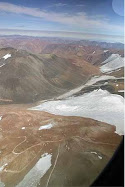
For several years now, the RRSE follows closely the various developments in connection with the Pascua-Lama project, put forward by the mining company Barrick Gold of Canada. Both in its scope (the project has a concession of 3 041 square km) and by its location overlooking the border of Chile and Argentina (in the middle of a semi-arid and desert at an altitude of 3 800 5 to 200 meters, the RRSE is of the opinion that this project presents significant risks with respect to the quality and accessibility of water for local people.

Following the precautionary principle, and considering that:


* Water is essential to life and the realization of all human rights; Water is essential to life and the realization of all human rights;

* The Pascua Lama mine will be located in a seismic zone, high elevation, upstream of the few sources of water of two inhabited valleys in Chile and Argentina that extraction by cyanidation will and that the complex will produce large quantities of dust and acid drainage, the Pascua Lama mine will be located in a seismic zone, high elevation, upstream of the few sources of water of two inhabited valleys in Chile and Argentina that extraction by cyanidation will and that the complex will produce large dust quantities and acid drainage;

* An accident, natural or industrial, could have significant and irreversible effect on the quantity and quality of water in the region, as well as the reputation and profitability of Barrick, an accident, natural or industrial, could have significant and irreversible effect on the quantity and quality of water in the region, as well as the reputation and profitability of Barrick;


The RRSE offered by way of a shareholder proposal that:


* Hires a management advisory panel of experts of international renown, independent in fact and in appearance, and familiar with best practices in relevant disciplines, for the reassurance on all aspects of the project, including the monitoring of post-safety exploitation; management engage an advisory panel of experts of international renown, independent in fact and in appearance, and familiar with best practices in relevant disciplines, for the reassurance on all aspects of the project, including follow-up safety post-operation;

* The panel released a summary annual independent recommendations of its members, the panel makes public an annual summary of the recommendations of independent members;

* The direction is not bound by the panel recommendations, but says, if so, why she chose not to follow the recommendations. management is not bound by the panel recommendations, but says, if so, why she chose not to follow the recommendations.

2009 Barrick Gold Shareholders meeting

© RRSE

Monday, April 28, 2008

Veladero Fronter of Chile /Argentina


Today along with another small crew of Canadian filmmakers from Canada along with some residents of the Valley of Husaco traveled several hours to the Barrick Gold, Veladero project.
WE left out our destination at 7am for the 3hour drive to the last small town of El Corral before travelling again 3 more hours to the frontier of Chile and Argentina


Concillors Luis Fuara and as well as Olca Co-ordinator and longtime friend and alley of the Anti Pascua Lama movement. It was the first time for most to travel this far outside of the valley to where several mining companys have been working in exploration.

Friday, April 11, 2008

Barrick tour of El Indio


Today along with the Alcaldesa of Vicuña Gloria Torres and representatives from community we visited the Mine El Indio In the III Region of Chile. We left Compania Minera Nevada's offices at 7am for the 3+ hour drive to the project with the superintendente of sustainable development of Barrick, Henry Martínez .

Prior to leaving we had to have a health exam with a doctor to be authorized to travel to the project .Upon arrival we had to follow up with another health exam on the day of to see if we were fit to travel up to the altitude of 4000m+ .

We were then treated to a lunch and video presentation of the Plan of Closure for El Indio as well as the many other projects of Barrick worldwide. People afterward were able to openly ask whatever question they had about the projects past and future operations. Some of the people's questions were quite about the negatives effects of the mines history up to this point.


check back to read rest of article

Sunday, April 1, 2007

Leaving Chile

After 4 months and 6 days in chile I am finally returning back to my other home of Toronto, Canada. It has been an incredible time here full of many firsts for me.
including my first Chilean passport, my first (adult) birthday in the city I was also born as well as dating my first Chilean girlfriend Carolina.
This farewell is bitter sweet as I say goodbye to all my new friends and family here that I have made. I feel that this is what I have been missing all my life since Leaving Chile for Canada over 30+ years ago. Living here and learning about my country its beautiful land and culture I have also learned much about myself.

"This trip travelling throughout Chile has changed me more than anything .I am not me anymore , at least I am not the same me I was before left."

Friday, March 2, 2007

Travelling to the Pascua Lama Project

This was my second time travelling to the Pascua Lama Project during my documentary . This time with a film crew and travelling with many of the people we have been following during my 4months here in northern Chile. This trip might have been cursed since we had problems from the beginning of our trip to the summit.

From scheduling problems to problems with the truck to the intense sun and high altitude it was amazing that we made it out in one piece. The photo was take at just over 4000m high with my soundperson Alex Torres and my camera person Emerson. Overall it was another amazing experience to be here again this time with so many friends . The next time I plan to stay over night for an entire day and night in order to see the sun set in the unlimited view of the world,

Christian Pena

Thursday, January 25, 2007

Urgent Action and Update: 48 Arrested at Pascua Lama Blockade, Chile

Protest camp, Conay Roadblock, Conay Camp assembly, Conay It's a beautiful day if you ignore the riot police. The special bus for transporting prisoners
Monday January 29, 2007 04:00 PM

After the arrests by the military police (Carabineros), the local community returned to re-take the intersection. The peaceful occupation and blockade of mining machinery will be maintained indefinitely.
Update from OLCA (Observatorio Latinoamericano de Conflictos Ambientales - Latin American Environmental Conflict Watch)
More than 80 people peacefully closed the intersection of the roads to Chollay and Conay, in the community of Alto del Carmen, beginning the night of Monday, January 22. The objective of the action was to prevent the entrance of trucks and vehicles of the mining companies that operate there, specially of Barrick Gold ("Responsible Mining") and its Pascua Lama project. The blockade turned back all mining machinery since the roads are not adequate for heavy machinery - a situation noted by the Chilean Environmental Commission (CONAMA), who prohibited this type of transport but has not enforced the prohibition.
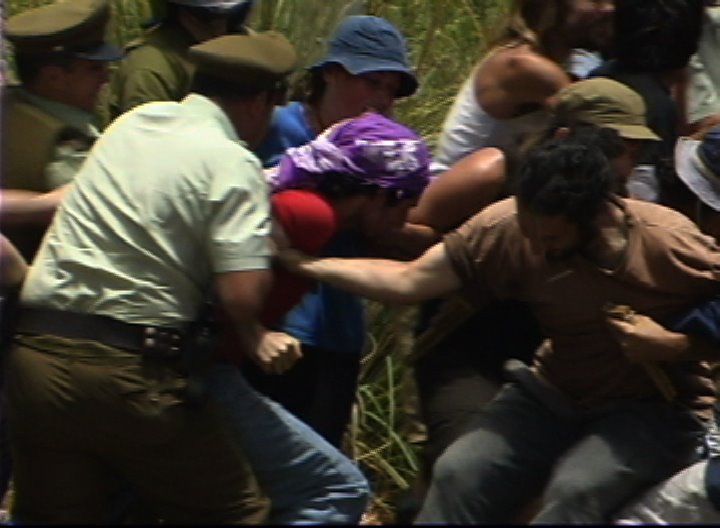
At 11:00 am on Thursday the 25th, between 30 and 40 Carabineros (military police) arrived, including special forces from Copiapó, by direct order of the Intendant of the Third Region (Atacama), to remove the demonstrators - which they proceeded to do at 2:00 pm. The people who had been blocking Barrick's vehicles resisted peacefully, linking arms until forced loose by military police officers. Upon arrest, the men were handcuffed and put on the police bus. Two of the 48 prisoners were minors and seven were foreigners. At least 60 people were at the blockade, including whole families, children, and one pregnant woman.

The prisoners were taken to the commissariat of Alto del Carmen and from there to Vallenar. They were freed after midnight, with charges of disorder in a public thoroughfare, although the foreigners were singled out for a "voluntary" procedure in which their documents were held by the authorities, obliging them to stay in the region at least two weeks. They were not allowed to make copies of their own declarations, and in the case of one French citizen, police altered his testimony and wanted him to sign their version and not the one he himself had written. All detainees were finally freed by about the 4:00 in the morning.
The local community, through the Defence Council of the Huasco Valley and the Church, monitored the release of the prisoners and was able to secure food and transport to satisfy the basic necessities even at those hours of the night. All the prisoners are well, although they reported injuries, mostly bruises and one sprained wrist.
The arrest procedure was irregular: the arrestees were not read their rights, and when at about 11 pm authorities said they would release the detainees if they signed a document that regularized the procedure, almost all the women refused to sign, because they had not been allowed to make any type of phone call, had not been informed of the reasons for their arrest, had not been allowed to contact lawyers or family members, and had been subject to illegal body searches.
Meanwhile, at the Chollay-Conay crossroads, once the peaceful blockade had been removed and police cleared the way for the illegal passage of earth-moving machinery (village organisations of the Transito Valley had obtained a ruling prohibiting the passage of these vehicles because of the inadequate roads), the local community returned to take the crossroads. The peaceful occupation and blockade of mining machinery will be maintained indefinitely.
Most of the arrestees, by decision in assembly, will return to support the occupation and work with solidarity networks. Village associations of Chollay, Conay, Los Tambos, Chigüinto, La Pampa, and other social organizations of the region have promised their support and are organizing food drives, information dissemination, and local activities in their own villages.
What You Can Do:
Write to Chilean national and regional authorities, with a copy to Canadian authorities, to urge them to respect the right of the communities of the Huasco Valley to express their opinions and demonstrate without repression; to respect the right of foreigners to protest mining projects that are international in their scope and impacts, and that they act to protect the interests of the communities -- not just those of Barrick Gold and the other transnational mining companies active in the region.