Barrick buys governments open up the exploitation of Pascua Lama
We denounce the interference of the transnational Barrick Gold mining in the internal decisions of the Republics of Chile and Argentina, after which senior executives of the two Canadian mining sustain top level meetings to press for the mandatory two nations, for the sole purpose unlock of the binational project Pascua Lama resisted.
This is part of the pressures that executives of the mine had to explain to the annual shareholders meeting that Barrick made in Toronto, Canada, and nine years ago, has had to explain the reasons for delaying the construction of the project star of the transnational. This is because almost ten years ago that was environmentally Pascua Lama, and still can not draw an ounce of gold. Something not right with the Chilean-Argentine border to the giant gold.
As broadcast by the media, the meeting between Barrick and Bachelet was held at the Palacio de La Moneda in camera and without making statements to the press on Saturday April 25 at 18 hrs. The President received the Executive Director of the Canadian transnational, Aaron Regent, the Deputy Director of the company, José Antonio Urrutia, accompanied by Chilean Minister of Mining, Santiago González.
The same happened on April 15 in the neighboring Republic of Argentina, where the founder and current president of Barrick, Peter Munk, also held a meeting behind closed doors and no statements to the press with President Cristina Fernandez at the House Rosada, accompanied by one of the staunchest defenders of Barrick, the governor of San Juan, José Luis Gioja, alongside Aaron Regent.
Munk had left the company last year, but according to the press, will not leave until Barrick announced the initiation of construction of Pascua Lama, who is the star of the transnational project and now looks more like the karma of the company. Munk is why the announcement of plans to make long-awaited construction of the binational project these days.
For the ninth time he had to explain at the annual shareholders meeting on April 29 last, the governments of Chile and Argentina had taken a further step in the tax agreement, but were awaiting the final agreement to announce the holding power Project which threatens the life of the valley in Huasco Atacama. Somewhat vague so that the actions do not fall much, but keep the expectations for future economic returns.
Unpresentable is a visit of its kind, behind closed doors and without statements, when spreads on the new law on transparency of the state, labeled as scandalous that the senior executive of Barrick Gold have taken the opportunity to meet with the President of the Republic of Chile, where organizations are opposing the mining project, after almost ten years of struggle, only to have the Minister of Environment, Ana Lya Uriarte, who did not have the courage to review documents and government of the same company that realize the decrease in proceeds from the glaciers thousands of transnational intervention in the area. The same happened with the refusal of MEPs to vote on an inquiry by the Pascua Lama, who just retired and returned to vote not to approve other motions of the day. Happened five times in the National Congress of Chile. Neither the President has the will to receive the community Huasco valley at the government house, as it deserves in a "citizen government".
The only note that participation in this meeting, is an illegal action of a private company with the State of Chile, and thus with all citizens. Perhaps our President of Chile, think that the Director of Barrick Gold is a mining Chile ", such as the Mining Council advertised for people to believe that these are, indeed chilenas. However, the only company that provides truly Chile Codelco is in this guild, the other, almost do not pay taxes, and stop pollution, death, alcoholism and prostitution for where they spend. Responsible Mining Is that it?
The president of Barrick, Peter Munk, released from prison to an arms dealer, his former partner Adnan Kasshoggi. Today, global issues by Munk is a leading company that has run human rights where they have installed. It did so recently, Norway, who after a tough report, Barrick Gold excluded from pension funds by the human and ethical issues involved have a shareholder to a company in Papua New Guinea has been polluting a river with heavy metals, without evaluation of water quality, and hence he has been leaving the population susceptible to serious illnesses. ¿Meanwhile, in Chile it is at the Presidential Palace?
Unpresentable that Bachelet is not receiving the community to resist against this policy submissive in our national soil. The President could have asked for 15 workers killed in the operation of Pascua Lama that have occurred since 1994 in Chile, could also have requested information on the conditions that were laid off over 180 workers Huasco valley that excited by a better future were pressured to resign "voluntarily" after CONAMA approved the mining project. Could also ask why the only border crossing that has a "restricted" in Chile and is called Pascua Lama is coincidentally in the area of the mining project.
Denounce finally, that it is no coincidence that Munk has been through Chile and Argentina to try to unlock Pascua Lama, while Sebastian Bowen, assumed command as General Coordinator of the Coalition for a presidential candidate, Eduardo Frei (DC). Because while he was President Frei of Chile has signed next to the Carlos Menem trans Integration and Cooperation Treaty between Chile and Argentina mining in 1997, legal instrument that allows mining projects on the border, as the Pascua Lama project. But also, because last year Bowen appeared on November 2 with the executives of Barrick to hold the line on what they called "Atacama Commitment," and that has been damaging to the community of the valley Tuesday.
We can not fail to mention that Frei is also in the Political Committee to Belisario Velasco, father of the founders of Extend Communications, a strategic advisory firm that Barrick in Chile.
Is it possible to think that this reunion would have committed money to the presidential campaign of his coalition in exchange for the exploitation of the mining project resisted most of the last time called Pascua Lama?
Coordinator Against Pascua-Lama Santiago
Semillas de Agua
Showing posts with label Pascua Lama. Show all posts
Showing posts with label Pascua Lama. Show all posts
Sunday, May 3, 2009


Friday, January 30, 2009
Chile, Argentina nearing Pascua Lama tax deal

According to a recent Reuters story Jan 29 (Reuters) "Chile, Argentina nearing Pascua Lama tax deal"authorities in Chile and Argentina are very close to reaching a tax agreement that would allow miner Barrick Gold (ABX.TO) to start work on one of the world's largest gold projects, the Pascua Lama Project , a government minister told Reuters on Thursday.
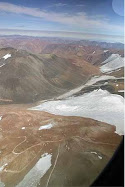
The Pascua Lama Project located in northern border of Chile and Argentina was the world's largest mega-gold find , after the Cerro Caslle project in the Copiapo area. It is located about 5,000 meters in altitude is currently the largest never open gold mine with a treasure of some 18 million ounces of gold .
The project, owned by Canada's Barrick Gold Corp (ABX.TO), overcame years of environmental challenges after Barrick agreed to leave nearby glaciers untouched. The project previously has been mired in years of delays due to low gold prices in 2000-2003 after the first SEIA study, a 2nd environmental study in 2004 that were suppose to relocate 3 glaciers (ice deposits) , as well as Supreme Court with a disgruntled miner Rodolfo Villar who’s case to this day also stalled the project .
The latest delay has been because of ongoing tax dispute between the host countries and discussing how to tax what they call transborder services, or services rendered by individual companies on either side of the border. As 80% of the gold is located on the Chilean side and 20% of the mineral on the Argentina side.
Mine construction in the Andes mountains of Chile do have a narrow window of opportunity , according to Henry Martinez of Barrick Gold, “the mining season to travel to Pascua Lama is between September 15 through end of March in some very warm years you can go there as late as did April". Construction is already years behind schedule since being approved in Chile and Argentina in 2006.
Sergio Gonzalez Minister of Mining said Barrick has not given Chile and Argentina a deadline to reach a deal. Even after over two years since the project was approved by the governments by both countries.
However in Sept of 2007 during a presentation at Icare when the project was said to begin construction that Fall ,the Canadian multinational Barrick Gold, could begin to be built only in Chile, following the lack of agreement with Argentina on the tax structure would the site., " Pascua Lama has all environmental permits approved , therefore, from that standpoint, in Chile in a position to start the project if they so wish, and so agree as a company," said Gonzalez said to reporters.
However this is also not true as all permits in Chile are not 100% ready according to Placdio Avilia Comana in the 3rd Region of Chile. A letter from Lucio Cuenca of OLCA was sent to him regarding as many as 14 permits in Chile that are not ready. “
If they were do this project in Chile only they would have to enter the Environmental Impact Study again. says Placido Avila.
Another major issue as to why they can not do this project in Chile only as the minister has said according to Fernando Gray, “The water , Barrick doesn’t have enough water to do this project in Chile only. They would need about 600l/s for the water treatment plant for its use in Chile, the 40- 50 l/s that Conama and company has always said they will use , however according to Gray that is only for the part of Extration: the Pascua camp , for the roads . That it was why they move the treatment plant to Argentina because they have the water”. Fernando Gray is the former President of La Junta de Viglencia of the Hausco Valley during 1992-2004 who was part of the 8 direcotrs who signed the initial $60 million protocol with Barrick and is very familiar with the history of the Barrick Gold Company in the Hausco valley.
Another small aspect that has not been discussed in the media is that Environmental agreements in Argentina eventually expire if the project has not begun or started construction unlike Chile ‘s Environmental agreement . The agreement signed by Barrick and the Argentina government authorities on Feb 15, 2006 has expired after Dec 31, 2008 so this would also require another SEIA study in Argentina further delaying the project according to Luis Faura former concillor of Alto Del Carmen.
However in a letter from Lucio Cuenca of OLCA was sent to Placdio Avilia of Comana of the 3rd Region of Chile regarding as many as 11 sectorial permits in Chile that are not not ready and the project for this reason can also not begin . “ A majority of the 11 permits are completed or advanced”. One such example is the bypass in the area of Alto del Carmen needs to be constructed before the construction of the project.
"Imagine walking away from a major gold mine at this time," he said. "They have neither postponed nor put a deadline on this project." Barrick Gold Chairman told Reuters at the World Economic Forum meeting in Davos he expected prices for the metal to hit new record highs, spurred by serious concern about the U.S. currency and doubt about the state of the world economy.
"There will most likely be a deal very soon," Mine Minister Santiago Gonzalez said in an interview. "Progress is being made and there could be a happy ending very soon."s
What is clear with all these and many more issues not mentioned the project is still many years away from if ever begin construction.
Conversation with Micheal Hesing
(response to Santiago Times article)
Study: Chile losing its glaciers
IN ENGLISH
What leaves me in this article is true, or more or less true. This is a fairly early stage of fighting for Pascua Lama in 2005.
When I visited the project, I took some pictures of "glaciers" El Toro 1 and 2 and Hope. In these photos can be seen that the "ice" Hope has an obvious impact of dust and there are also tracks for heavy machinery over this mass of ice. In fact, I handed these photos to the press and came across Chile and in part by the world. (I attached photos).
Having recorded this with my camera, I began to investigate, asking questions really "dumb" to the people of Barrick, but the field staff. Well, finally gets to know that the work done Barrick operating in ice, means that drilled in the ice mass of Hope. In addition I found a table in the casino of Barrick, the Barriales camp, where there was just the drill at the Hope. Well much to ask, this table disappeared quickly from the wall of the casino and then publicly denied that Barrick has gotten boring in Hope. The effects of ice on the surface were evident, as you can see from the photos attached.
However it is not, as the article says that Barrick "solid material deposited on top of the glacier," but noted that the dust was the result of activities related to exploration work.
In the famous meeting with the commission of the environment, the chamber of deputies, the debate was put together on the issue whether or not Barrick was involved ice, which the representatives of the company flatly refused. Finally I asked the legislators to me if I consist of an intervention by the ice Barrick. Obviously he knew of the involvement of ice, because the photos that sparked the fight in Chile were all mine. Therefore my collection of photos relating to the issue to the committee, which triggered a strong displeasure at Barrick. (Of course, that at this point is simply not told the truth).
I think about my article is appointed clarifying some details:
1 .- As I said, I did not say that Barrick "solid material deposited on top of the Hope, that is simply not the case.
2 .- Following these developments, glaciologists, both on the side of Barrick (Canada) and the side of the Supervisory Board of the Rio Huasco (two Frenchmen and an Argentinian) unanimously determined that in the case of Toro 1 , Toro 2 and Esperanza is relictual ice that formed in ancient times only a glacier, but today it no longer meets the minimum requirements to be called "glaciers." Especially for the loss of mass and not enough ice plasticity that allows the movement that characterizes the true glaciers. Together with this lost their accumulation and ablation zones. Accordingly to the above, the glaciologists determined that the contribution of the mass of ice water in andalusia negligible. It should be clarified in this context that while the impact of dust and ice drilling above may adversely affect the albedo and the conservation of ice, is clearly not the fault of Barrick, which today These three mass of ice and glaciers are not. This process is too slow to link it with Barrick.
3 .- The above is not contradictory with the fact that nearby Pascua Lama project has two glaciers outside of the direct influence of the project, or the Straits and the Yellow Guanaco. Both have movement, accumulation and ablation areas well defined and significant troop flows, as you can see from the photos attached.
4 .- The Barrick is impacting the waters of the farmers is stupid, because the project is not working and not even started construction. Therefore there are no tanks or rajos sterile, which can generate acid drainage. Strong generation of acid drainage in the mineralized zone of the emerging River Strait is absolutely natural (so far!) And there ever since. Sanitas as water, crystal and so on. etc. from glaciers, evoking environmentalists, are a myth. At least there is this water that was installed before the first farmer in the valley, as it is in process of geological time. I think it gives you when you were in Chile, to all the information you can check everything yourself.
Well, that about the old days. Currently Barrick submitted a Limestone Mining Project, located near Pascua Lama. The end of the project is to produce calcium Pascua Lama inputs required in the plant leaching of gold (cyanidation), since the process requires an alkaline environment. Moreover they could also be used to plant HDS, which neutralizes the acid water tank sterile. (In the background that raises the pH to precipitate metals).
The Barrick was sufficiently "side stick" to enter the Project Evaluation System as a declaration and not a study. That there is not even participation. The worst thing is that it seems that the services they want to tolerate this state of Barrick.
Furthermore I believe it is legally questionable whether they can super-boot with a DIA and no more.
One detail that Barrick is also not ruled out the use of hazardous waste, pet coke as fuel in lime kilns. Besides threatening wetland flora and fauna conservation problems and so on. etc ....
And what you think, where environmentalists are our friends? Just do not appear. Well, it seems Pascua Lama became fashionable. I took, of course, the "nuisance" to observe the project for a group of irrigators.
Currently, this presented another Mega Mining Project "El Morro" in the Huasco Valley. I was hired back as an adviser to the Supervisory Board Huasco River. This project is in full time and still do not know that we will "make clean".
IN SPANISH
Lo que sale de mi en este articulo es cierto, o mas o menos cierto. Este hecho corresponde a una fase bastante temprana de las peleas por Pascua Lama en el año 2005.
Cuando visité el proyecto, tomé algunas fotos de los “glaciares” El Toro 1 y 2 y Esperanza. En estas fotos se puede apreciar, que el “glaciar” Esperanza tiene un evidente impacto de polvos y además existen huellas para maquinaria pesada encima de esta masa de hielo. De hecho, yo entregue estas fotos a la prensa y así salieron por todo Chile y en parte por el mundo. (Te adjunto las fotos).
Después de haber registrado esto con mi cámara, empecé a investigar, en realidad haciendo preguntas “tontas” a la misma gente de la Barrick, pero al personal de terreno. Bueno, finalmente llegue a saber que la Barrick realizaba trabajos de explotación en estos hielos, quiere decir, que perforó en la masa de hielo del Esperanza. Además encontré un cuadro en el casino de la Barrick, en el campamento Barriales, donde se apreciaba justamente las perforadoras en el Esperanza. Bueno de tanto preguntar, desapareció rápidamente este cuadro de la pared del casino y posteriormente la Barrick negó públicamente que ha metido perforadoras en el Esperanza. Los efectos en la superficie del hielo eran evidentes, como tú puedes apreciar en las fotos adjuntas.
De todas maneras no es así, como dice el artículo, que la Barrick “depositó material sólido encima del glaciar”, si no el polvo que se observa era consecuencia de las actividades relacionadas a trabajos de exploración.
En la famosa reunión con la comisión del medio ambiente, de la cámara de diputados, se armó el debate sobre el tema si la Barrick ha intervenido o no hielos, hecho que los representantes de la empresa negaron rotundamente. Finalmente me preguntaron los legisladores a mi si me constará una intervención de hielos por parte de la Barrick. Lógicamente sabía de la intervención de los hielos, dado que las fotos que encendieron esta pelea en todo Chile eran mías. En consecuencia presenté mi colección completa de fotos relacionadas al tema a la comisión, lo que desató un fuerte disgusto en la Barrick. (Claro, por que en este momento simplemente no dijeron la verdad).
Creo que al respecto del artículo que me nombra hay que aclara algunos detalles:
1.- Como ya he expresado, no dije que la Barrick “depositó material sólido encima del Esperanza, por que simplemente no es así.
2.- Posteriormente a estos hechos, los glaciólogos, tanto del lado de la Barrick (canadienses) como del lado de la Junta de Vigilancia del Río Huasco (un argentino y dos franceses) determinaron en forma unánime, que en el caso del Toro 1, Toro 2 y Esperanza se trata de hielos relictos, que formaron en tiempos remotos un solo glaciar, pero hoy en día ya no reúnen las condiciones mínimas para poder ser denominados “glaciares”. En especial por su pérdida de masa ya no alcanzan la plasticidad del hielo que permite el movimiento que caracteriza a los verdaderos glaciares. Junto a esto perdieron sus zonas de acumulación y ablación. En consecuencia a lo expresado anteriormente, los glaciólogos determinaron que el aporte de estas masa de hielo al recurso hídrico en insignificante. Se debe aclarar en este contexto, que si bien un impacto de polvo y otro de perforaciones encima de los hielos pueden influir negativamente en el albedo y en la conservación de las masas de hielo, claramente no es culpa de la Barrick, que hoy en día estas tres masa de hielo ya no son glaciares. Este proceso es demasiado lento para vincularlo con la Barrick.
3.- Lo expuesto anteriormente no es contradictorio con el hecho que en cercanía del Proyecto Pascua Lama existen dos glaciares, fuera del área de influencia directa del Proyecto, el Estrecho o Amarillo y el Guanaco. Ambos tienen movimiento, zonas de acumulación y ablación bien definidas y además aportan caudales significantes, como puedes apreciar en las fotos que adjunté.
4.- Que la Barrick esta impactando las aguas de los agricultores es una estupidez, dado que el Proyecto no esta operando y ni siquiera comenzó su construcción. En consecuencia no existen rajos o depósitos de estériles, que pueden generar drenaje ácido. La fuerte generación de drenaje ácido en la zona mineralizada de la naciente del Río Estrecho es absolutamente natural (hasta ahora!) y existe desde siempre. Las aguas tan sanitas, cristalinas etc. etc. provenientes de los glaciares, que evocan los ambientalistas, son un mito. Por lo menos esta agua no existe desde antes que se instaló el primer agricultor en el valle, dado que se trata de proceso en tiempos geológicos. Creo que te facilité, cuando estabas en Chile, toda la información para que tu puedes comprobar todo tu mismo.
Bueno, esto sobre los viejos tiempos. Actualmente la Barrick presentó un Proyecto Minero de Caliza, ubicado muy cerca de Pascua Lama. El fin del Proyecto es producir insumos cálcicos para Pascua Lama, requeridos, en la en la planta de lixiviación de oro (cianuración), dado que el proceso requiere un ambiente alcalino. Además les podría servir también para la Planta HDS, que neutraliza las aguas ácidas del depósito de estériles. (En el fondo se sube el pH hasta que precipitan los metales).
La Barrick era suficientemente “cara de palo” para ingresar este Proyecto al Sistema de Evaluación como declaración y no como Estudio. Con esto no existe ni siquiera participación ciudadana. Lo peor es que parece que los servicios estatales quieren tolerar esto a la Barrick.
Además a mi juicio es legalmente súper cuestionable si pueden arrancar con una D.I.A. así no mas.
Un detalle es también que la Barrick no descarta el uso del residuo peligroso, pet coke, como combustible en los hornos de cal. A parte amenazan humedales con flora y fauna con problemas de conservación etc. etc….
¿Y que crees tú, donde están nuestros amigos ambientalistas? Simplemente no aparecen. Bueno, parece Pascua Lama pasó de moda. Me tomé, por supuesto, la “molestia “, de observar el Proyecto para un grupo de regantes.
Actualmente esta presentado otro Mega Proyecto Minero “El Morro” en el Valle de Huasco. Me contrataron nuevamente como asesora del La Junta de Vigilancia del Río Huasco. Este Proyecto esta en el momento en pleno desarrollo y todavía no se sabe que vamos a “sacar en limpio”.
Michaela
Saturday, September 20, 2008
Who is 100% Owner of Mina Pascua ?
 After many weeks of Pascua Lama news the ongoing delays and the complicated tax issues in Chile and Argentina another story has begun to emerge from the depths of Mina Pascua. A Chilean miner living in Vancouver Canada known as Jorge Lopehandia has been filing documents to the authorizes in Chile and Canada saying that he is 100% owner of Mina Pascua.
Up until now the name of another miner Rodolfo Villar who went to the Supreme court to say he was hoodwinked by the company Barrick Gold has gotten all news coverage. The sale of his titles for 10,000 pesos or $20 US and the court case at the 14th Civil Court in Santiago which rendered the contract NULL and VOID. Barrick responded to this court decision saying it was a nucicence suit.
According to Vince Borg Senor Vice President , Corporate Communications, the lawsuit will not affect the development of Pascua-Lama.“We do not believe that the project's development will not be impacted. The claims ( Rodolfo Villar) in question do not affect the area of mineralization. They also will not affect the development of the project infrastructure,” he said.
He said he was unsure of how much exploration potential there is on these claims, but “I suspect not high.”
this was from that article " & Silver
Prospector Wins Initial Court Ruling on Barrick's Pascua Lama "
about the court case
Prospector Wins Initial Court Ruling on Barrick's Pascua Lama "
about the court case
However the little know fact is that Rodolfo Villar is an employee of Jorge Lopehandia and that Rodolfo went to sell the land title to Barrick Gold behind Jorge's back.
He was sued by Barrick Gold in Canada for libel in lawsuit the first of its kind in Canada . In order to silence and discredit him from accusations he was trying to publish online in this complicated story of Now after years in the background and himself being sued by the company for the first Internet backstabbing and raw deals.
Here is an excerpt told by Jorge to me about the deal between Rodolfo Villar when trying to sell titles as he needed money to maintain claims near Mina Pascua.
the fact is that Villar was authorized by Jorge "to dsign off as soon as John lill calls you as we have agreed to a transaction - 1996 as told by Jorge Lopehandia to Rodolfo Villar prior to Barrick ever meeting Villar or entering into business with ALEJANDRO MORENO at Pascua 1997"
"Rodolfo Villar told a lawyer Alejandro Moreno Prohens that he could not find me and needed $ to maintain claims near Pascua I sold to Barrick... MORENO told Villar NO WAY let me help I have cash... Villar gave the info to MORENO and MORENO re-claimed Villar's new discovery to MORENO'S NAME, and with this he went to Barrick to get 280 million and IN THE SAME (MORENO) CONTRACT get Villar 10,000 poesos for 8600 hectares
MORENO taught Barrick how to claim jump me after he claim jumped VILLAR
It is all in the anals of mining Registrar in Chile"...
When asked if Jorge is a claim jumper this case he responded. " No I am not a claim jumper, Barrick lost the area to its fraud to Chile and Mining Code when I claimed 1996. My areas are 100 % Mina Pascua and Vince Borg's Declaration make him liable to me and to his shareholders/banks and Chile itself.
He went on to explain more of the sorted detail
"We did not claim jump, Barrick lost the area to fraud to Chilean Mining Code and I proved this to John Lill in 1996, it was after Barrick discovered I was right that they JUMPED my AMARILLOS - correct at law discovery.... if their claims were right and I jumped their good claims... why TESOROS of Unda Lannos I seized judicially... why the rest of subsequent guanaco and burro pastures for Barrick thereat?"
In Chile there is a law against IMAGINARY CONTRACTS & TRANSACTIONS penalized with 5years 1 day per . barrick did many $10,000 pesos contracts near Pascua (self admitted in Trial in our case)
"The difference between today and last year when i sent out all this information to anyone who would listen is that I am now 100% owner of MinaPascua and I have all the documentation to prove it", says Jorge Lopehandia.
All I know is that on paper Jorge Lopehandia is the current title holder of Mina Pascua , how he got there is another story. This is a fight amongst miners ,who is the original owner and who holds the title today and who committed fraud," says Daniel Yanez freelance reporter for El Siglo who has written many articles on the Pascua Lama case and has follow Jorge Lopendia's story.
Whether or not this case gets any attention in the Chilean or Canadian media this ongoing saga of who is the rightful owner of Mina Pascua will continue. Only time will tell if the company can whether this latest storm as they have tried to maintain that everything is under control with respect to the advancements and on going delays with Project Mina Pascua (Lama).
Check back for more ongoing developments on this story .
http://pascualamaproject.blogspot.com/
LETTER TO FISCAL de CONAMA
Sr. Rodrigo Guzman, Fiscal de CONAMA CHILE,
And,
Secretarías Regionales Ministeriales (SEREMI) de Minería
Dear Sirs: Via email
Re: Cia Minera Nevada SA (“Nevada”) and Mina Pascua: Barrick Gold Corporation (“Barrick”) and the “Pascua Lama” mining project (the “Project”)
We are the solicitors for Jorge Rodrigo Lopehandia, who possesses a general Power of Attorney as noted in the margins of the enclosed mining titles to the “Amarillo Norte and Amarillo Sur” mining claims.
Our client is concerned with the activities of Nevada and its claims of ownership of the Project in Chile. As you may be aware, the Courts in Santiago have ruled on the ownership of the claims referenced, referred to as “Amarillo” and “Tesoro”. Attached is a true copy of the Tesoro Claims with the continuing Injunction noted therein, and the Court Judgments for your review and reference.
We also attach for your review and reference the following:
1. A Technical Report dated march 30, 2005 [see page 43 ,Figure 9.2] and Barrick Shareholders’ Report dated November 30, 2006 [see page 16] as published by Barrick in Canada, wherein the UTM co-ordinates of the ore body (mining pit) are indicated;
2. A Satellite Image (the “Image”) of the Tesoro Claims showing the UTM co-ordinates of the Tesoro Claims, as prepared by Golder Associates, Professional Engineers;
3. A “Mountain Image” of the Pascua Lama Project as advertised by Barrick in Chile.
From a review of the UTMs shown in the Technical Report published by Barrick, and those UTM’s shown in the Barrick Shareholders’ Report, as compared to the UTMs shown in the Image, it is clear that the Tesoro Claims (which are the subject of the “Villar v. Nevada” Court case in Santiago) contain the ore body / mining pit of Mina Pascua.
With respect, Barrick’s claims as set out in their News Release dated October 11, 2007, attached, cannot be reconciled with the Court Judgment documents nor with the UTM co-ordinates as attached.
Accordingly, we ask that you assist Jorge Lopehandia by:
1. providing Barrick’s Environmental Impact Study;
2. providing the description of the areas of the Pascua project as represented to you by Barrick;
3. request that Barrick proves to your satisfaction that Barrick or Nevada owns current valid claims that are located near the Amarillos Sur / Norte claims, that have been owned by Barrick / Nevada prior to 1996;
4. request that Barrick provide details of the UTMs of the drilled ore body and proven reserves of Pascua that were sold to Deutsche Bank AG in 2005 from the Mina Pascua (Chile) as per the attached link: ;
5. request that Barrick provide details of the UTMs of the drilled ore body and proven reserves of Pascua that were sold as Royalties to International Royalty Corporation as detailed in the link: and as referenced in the following e-letter text received from International Royalty Corporation (“ROY”):
“dateTue, Jul 8, 2008 at 8:54 AM
subjectRE: Pascua NSR Royalty purchased from Barrick: Problem
Dave,
Thank you for your interest in International Royalty Corporation. I have done some research, and according to our lawyers in Santiago, the area covered by the lawsuit you mention below” [ref: Villar v. Cia Minera Nevada] “is very far to the north of the orebody. Please let me know if you have any other questions or concerns on the company.
Best regards,
Jack Perkins
Director of Investor Relations
International Royalty Corporation
303 991-9500”
With respect, if what is represented by ROY is correct, which cannot be substantiated by the UTM co-ordinates referenced above, would that not put the Pascua ore body in Region IV?
Friday, September 19, 2008


Tuesday, August 12, 2008
PASCUA LAMA MINE PLANS STILL AT STANDSTILL

Plans for Chile and Argentina's first shared mining project has hit a two-year delay as Argentinean President Cristina Fernández neglected to approve Chile's tax revenue distribution proposals, Chilean daily El Mercurio reported Monday.
Chile modified its tax distribution proposal in June in Argentina's favor as a solution to the split, but Argentina still found the deal insufficient. Since Argentina is confronting agriculture strikes and fighting tax battles within its own country, the Fernández government has put the proposal aside and dialogue between trans-Andean authorities has been shut off.
As several other million-dollar projects are collecting dust within the Bi-national Commission for the Mining Deal, authorities stress that the resolution to the Pascua Lama mine is important in order for other bi-national projects to proceed.
More than 17 million ounces of gold, as well as silver and copper deposits, sit in the mine-to-be of Canadian driller Barrick Gold, who had hoped to begin a US$3 billion mine construction in September (ST May 19). But delays in the tax revenue allocation plan, various sector permits pending in Argentina and resurfacing environmental contamination concerns (ST May 8) have pushed construction plans back two years.
If Pascua Lama is constructed, Chile's second largest gold source would produce 600,000 ounces of gold and 23 million ounces of silver a year, as well as smaller quantities of copper. The mine's tax revenues would be expected to sum up to US$7 billion in total (ST Sept 12, 2007).
SOURCE: EL MERCURIO
By Elaine Ramirez ( editor@santiagotimes.cl)
Friday, August 8, 2008
CHILE'S REGION III SURPASSES REGION II IN MINING EXPLORATION
| |  |  |  |
| Friday, 08 August 2008 | |
| The Atacama zone of Chile’s Region III registered 8,518 mining exploration grants in 2007, an increase of 11.6 percent, surpassing the 7,044 grants in Antofagasta (Region II) for the first time ever. According to the latest Yearly Report on Chilean Mining, published by the National Service of Mining and Geology (SERNAGEOMIN), Atacama accounted for 22.7 percent of the Chilean mining exploration area, edging out Antofagasta’s 22.4 percent share. The vast area and abundance of exploration opportunities in Atacama have made the zone the most active mining site in Chile. Atacama boasted 2,326,700 hectares (1 hectare equals 10,000 square meters) of mining sites in 2007, compared to Antofagasta’s 2,298,400 hectares, which dropped by 23 percent from 2006. “Atacama’s large diversity and great potential from the geological standpoint is attracting exploration from all types of companies,” said Juan Carlos Guajardo, executive director of the Center for Copper and Mining Studies (CESCO). “Region III has large deposits of copper and gold as well as titanium and nonmetallic minerals. Because of this, Atacama is generating a lot of interest from a variety of miners.” Alejandro Vío, national director of SERNAGEOMIN, believes that more junior mining companies are exploring Region III due to its great stock of mining sites, which is creating an important dynamic in terms of mining exploration. Over US$7 billion has been invested in the region, according to government estimates. Among the main projects in the zone are Pascua Lama (Barrick Gold), Relincho (Tech Cominco), Caserones (Nippon Mining), El Morro (Xstrata Copper and Metallica Resources Limited) and Inca de Oro. Next Sunday the National Society of Mining (SONAMI) will celebrate a “Mining Day” in the Atacama city of Tierra Amarilla, because of the leading role the area is playing in Chile’s mining industry. President Michelle Bachelet will attend the event, together with public and private authorities. |
Tuesday, May 6, 2008
Barrick Shareholders ask to vote on shareholder proposal on Pascua Lama project


(See video clip of Pascua Lama proposal below)
For several years now, the RRSE follows closely the various developments in connection with the Pascua-Lama project, put forward by the mining company Barrick Gold of Canada. Both in its scope (the project has a concession of 3 041 square km) and by its location overlooking the border of Chile and Argentina (in the middle of a semi-arid and desert at an altitude of 3 800 5 to 200 meters, the RRSE is of the opinion that this project presents significant risks with respect to the quality and accessibility of water for local people.
Following the precautionary principle, and considering that:
* Water is essential to life and the realization of all human rights; Water is essential to life and the realization of all human rights;
* The Pascua Lama mine will be located in a seismic zone, high elevation, upstream of the few sources of water of two inhabited valleys in Chile and Argentina that extraction by cyanidation will and that the complex will produce large quantities of dust and acid drainage, the Pascua Lama mine will be located in a seismic zone, high elevation, upstream of the few sources of water of two inhabited valleys in Chile and Argentina that extraction by cyanidation will and that the complex will produce large dust quantities and acid drainage;
* An accident, natural or industrial, could have significant and irreversible effect on the quantity and quality of water in the region, as well as the reputation and profitability of Barrick, an accident, natural or industrial, could have significant and irreversible effect on the quantity and quality of water in the region, as well as the reputation and profitability of Barrick;
The RRSE offered by way of a shareholder proposal that:
* Hires a management advisory panel of experts of international renown, independent in fact and in appearance, and familiar with best practices in relevant disciplines, for the reassurance on all aspects of the project, including the monitoring of post-safety exploitation; management engage an advisory panel of experts of international renown, independent in fact and in appearance, and familiar with best practices in relevant disciplines, for the reassurance on all aspects of the project, including follow-up safety post-operation;
* The panel released a summary annual independent recommendations of its members, the panel makes public an annual summary of the recommendations of independent members;
* The direction is not bound by the panel recommendations, but says, if so, why she chose not to follow the recommendations. management is not bound by the panel recommendations, but says, if so, why she chose not to follow the recommendations.
2009 Barrick Gold Shareholders meeting
© RRSE
Monday, April 28, 2008
Veladero Fronter of Chile /Argentina

Today along with another small crew of Canadian filmmakers from Canada along with some residents of the Valley of Husaco traveled several hours to the Barrick Gold, Veladero project.
WE left out our destination at 7am for the 3hour drive to the last small town of El Corral before travelling again 3 more hours to the frontier of Chile and Argentina
Concillors Luis Fuara and as well as Olca Co-ordinator and longtime friend and alley of the Anti Pascua Lama movement. It was the first time for most to travel this far outside of the valley to where several mining companys have been working in exploration.
Friday, March 2, 2007
Travelling to the Pascua Lama Project
This was my second time travelling to the Pascua Lama Project during my documentary . This time with a film crew and travelling with many of the people we have been following during my 4months here in northern Chile. This trip might have been cursed since we had problems from the beginning of our trip to the summit.
From scheduling problems to problems with the truck to the intense sun and high altitude it was amazing that we made it out in one piece. The photo was take at just over 4000m high with my soundperson Alex Torres and my camera person Emerson. Overall it was another amazing experience to be here again this time with so many friends . The next time I plan to stay over night for an entire day and night in order to see the sun set in the unlimited view of the world,
Christian Pena
From scheduling problems to problems with the truck to the intense sun and high altitude it was amazing that we made it out in one piece. The photo was take at just over 4000m high with my soundperson Alex Torres and my camera person Emerson. Overall it was another amazing experience to be here again this time with so many friends . The next time I plan to stay over night for an entire day and night in order to see the sun set in the unlimited view of the world,
Christian Pena
Thursday, January 25, 2007
Urgent Action and Update: 48 Arrested at Pascua Lama Blockade, Chile
Protest camp, Conay Roadblock, Conay Camp assembly, Conay It's a beautiful day if you ignore the riot police. The special bus for transporting prisoners
Monday January 29, 2007 04:00 PM
After the arrests by the military police (Carabineros), the local community returned to re-take the intersection. The peaceful occupation and blockade of mining machinery will be maintained indefinitely.
Update from OLCA (Observatorio Latinoamericano de Conflictos Ambientales - Latin American Environmental Conflict Watch)
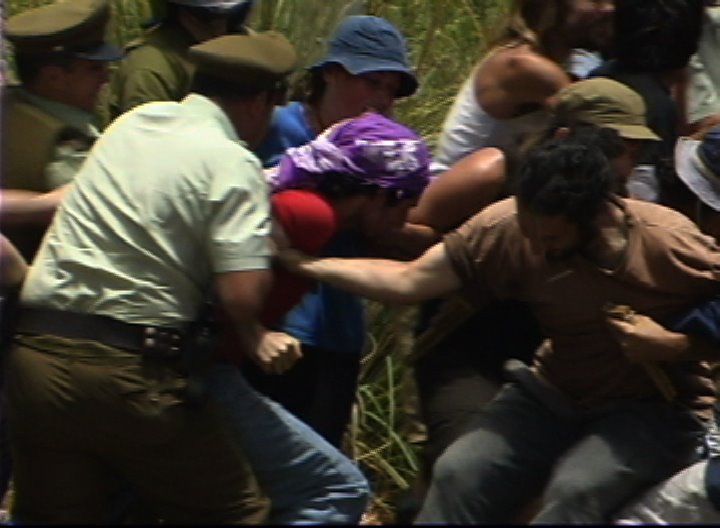
More than 80 people peacefully closed the intersection of the roads to Chollay and Conay, in the community of Alto del Carmen, beginning the night of Monday, January 22. The objective of the action was to prevent the entrance of trucks and vehicles of the mining companies that operate there, specially of Barrick Gold ("Responsible Mining") and its Pascua Lama project. The blockade turned back all mining machinery since the roads are not adequate for heavy machinery - a situation noted by the Chilean Environmental Commission (CONAMA), who prohibited this type of transport but has not enforced the prohibition.
At 11:00 am on Thursday the 25th, between 30 and 40 Carabineros (military police) arrived, including special forces from Copiapó, by direct order of the Intendant of the Third Region (Atacama), to remove the demonstrators - which they proceeded to do at 2:00 pm. The people who had been blocking Barrick's vehicles resisted peacefully, linking arms until forced loose by military police officers. Upon arrest, the men were handcuffed and put on the police bus. Two of the 48 prisoners were minors and seven were foreigners. At least 60 people were at the blockade, including whole families, children, and one pregnant woman.
The prisoners were taken to the commissariat of Alto del Carmen and from there to Vallenar. They were freed after midnight, with charges of disorder in a public thoroughfare, although the foreigners were singled out for a "voluntary" procedure in which their documents were held by the authorities, obliging them to stay in the region at least two weeks. They were not allowed to make copies of their own declarations, and in the case of one French citizen, police altered his testimony and wanted him to sign their version and not the one he himself had written. All detainees were finally freed by about the 4:00 in the morning.
The local community, through the Defence Council of the Huasco Valley and the Church, monitored the release of the prisoners and was able to secure food and transport to satisfy the basic necessities even at those hours of the night. All the prisoners are well, although they reported injuries, mostly bruises and one sprained wrist.
The arrest procedure was irregular: the arrestees were not read their rights, and when at about 11 pm authorities said they would release the detainees if they signed a document that regularized the procedure, almost all the women refused to sign, because they had not been allowed to make any type of phone call, had not been informed of the reasons for their arrest, had not been allowed to contact lawyers or family members, and had been subject to illegal body searches.
Meanwhile, at the Chollay-Conay crossroads, once the peaceful blockade had been removed and police cleared the way for the illegal passage of earth-moving machinery (village organisations of the Transito Valley had obtained a ruling prohibiting the passage of these vehicles because of the inadequate roads), the local community returned to take the crossroads. The peaceful occupation and blockade of mining machinery will be maintained indefinitely.
Most of the arrestees, by decision in assembly, will return to support the occupation and work with solidarity networks. Village associations of Chollay, Conay, Los Tambos, Chigüinto, La Pampa, and other social organizations of the region have promised their support and are organizing food drives, information dissemination, and local activities in their own villages.
What You Can Do:
Write to Chilean national and regional authorities, with a copy to Canadian authorities, to urge them to respect the right of the communities of the Huasco Valley to express their opinions and demonstrate without repression; to respect the right of foreigners to protest mining projects that are international in their scope and impacts, and that they act to protect the interests of the communities -- not just those of Barrick Gold and the other transnational mining companies active in the region.
Sunday, December 10, 2006

Subscribe to:
Posts (Atom)